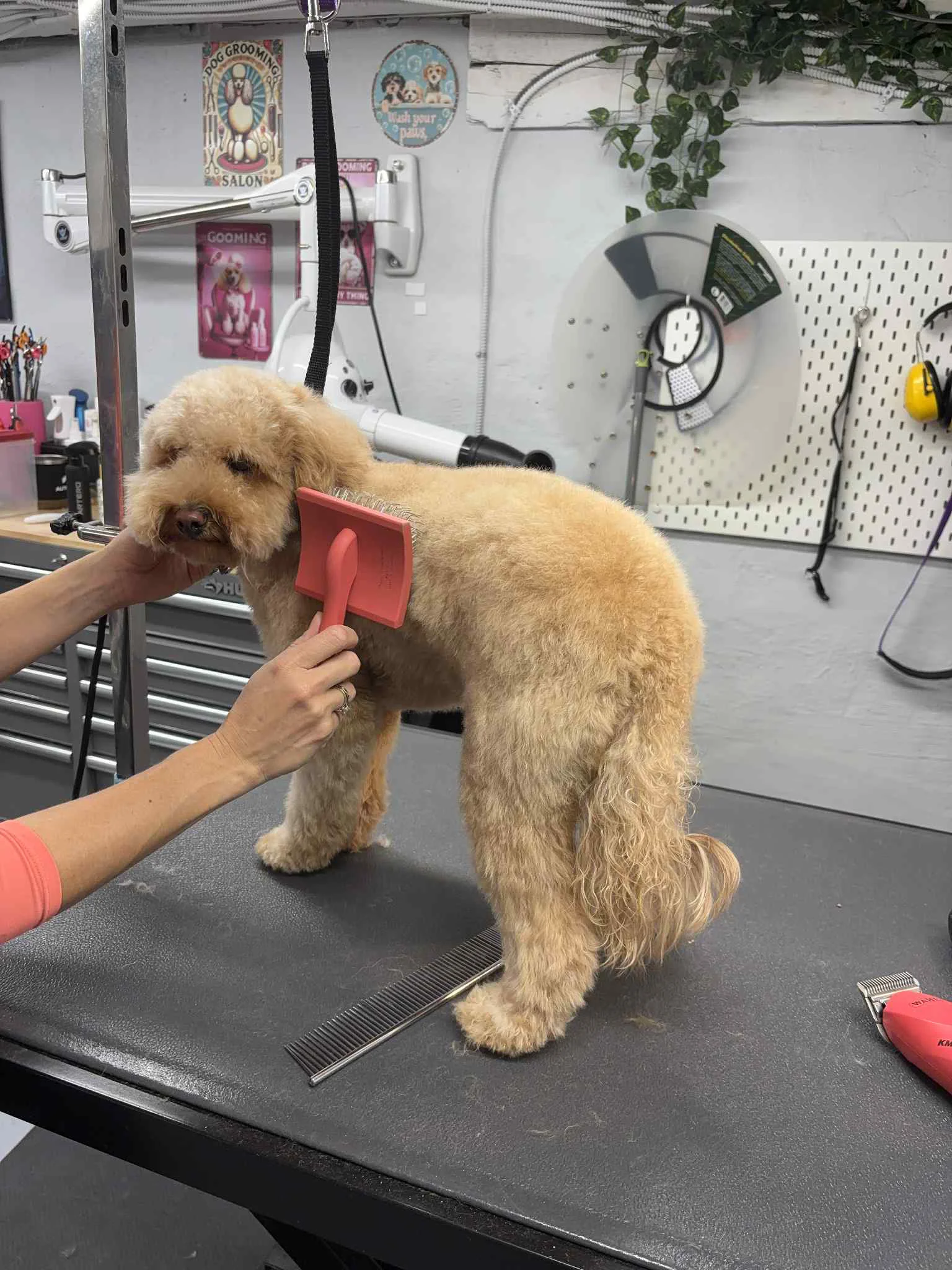
Doodle Grooming in Toronto
Goldendoodles, bernedoodles and cockapoos — and honest advice about the coat
The doodle coat is the whole job
Almost every doodle appointment we take at 550A College Street comes down to one thing: the condition of the coat when the dog walks in. Not the haircut style, not the breed mix, not the size of the dog. The coat.
Doodles were sold to a lot of Toronto families as low-shedding dogs, and that part is usually true. What did not come with the puppy is that low-shedding and low-maintenance are opposites. A doodle in a teddy bear cut is one of the highest-maintenance coats in dog grooming, and the difference between a lovely groom and a shave-down is usually what happened in the six weeks before the appointment.
This page is what we tell doodle owners in person: why the coat mats, what a teddy bear cut actually involves, how much brushing it really takes, and what we do when a coat has gone too far to save.
Why doodles mat — the real mechanism
A doodle inherits poodle curl on one side and a retriever, bernese, or spaniel undercoat on the other. Every dog loses hair. On a labrador it falls out onto your floor. On a doodle the curl catches it and holds it.
That trapped hair twists around the coat next to it, and the tangle tightens every time your dog moves, gets wet, rolls, or wears a harness. Left alone it stops being a tangle and becomes felt — a dense mat lying flat against the skin, pulling on it, keeping air and water out.
Here is the part that catches people out: a felted coat can look completely fine. The surface stays fluffy and brushes beautifully, because your brush is only touching the top centimetre. The mat is underneath, at skin level, where the brush never reaches.
| Coat type | What it does | Brushing needed |
|---|---|---|
| Curly | Tight poodle-like curl. Holds shed hair the hardest and mats the fastest, often within days. | Daily to every other day |
| Wavy | The classic teddy bear look, and the coat most owners underestimate. Mats quietly under the surface. | 3–4 times a week |
| Straight or flat | More retriever than poodle. Sheds more visibly, mats least, but still felts behind the ears and on the legs. | 2–3 times a week |
The coat change nobody warns you about
Somewhere between roughly seven and fourteen months, your doodle swaps its soft puppy coat for a denser adult coat. For a while both coats are on the dog at once, and the shedding puppy coat gets caught in the incoming adult coat.
This is when we meet the most matted dogs, and the owners are almost never neglectful — they are brushing exactly as much as they were three months earlier, and it stopped being enough. If your doodle is coming up on a year old, this is the moment to add sessions, not to relax. It is also a good moment for a puppy grooming visit if your dog has not been on a table yet.
Where mats start first
Mats form where there is friction or moisture. If you only have five minutes, spend them here rather than on the back, which is the easiest part of the dog and the part everyone brushes.
- Behind and under the ears, where the coat rubs constantly
- Under the collar and harness straps
- Armpits and groin, where friction never stops
- Base of the tail and the back of the thighs
- Pantaloons — the long hair on the back legs
- Between the toes and around the paw pads
- The chest and chin, on dogs who drink messily
The teddy bear cut: what it is, what it takes
A teddy bear cut is a rounded head with the muzzle left full and shaped into a soft circle, ears blended into the head, cylindrical legs, and one even length over the body. It is the look almost every doodle owner asks for by name, and it is the reason doodle grooming takes as long as it does.
The critical thing to understand is that a teddy bear cut is scissor work performed on an already-perfect coat. The mats have to be gone before the shape can begin, because a mat holds the hair at the wrong length and the finish comes out uneven. There is no version of this haircut that works around matting.
Full brush-out and comb-through
Before a single scissor cut, the coat has to be free of tangles from the skin out. On a medium doodle this stage alone can run an hour. You cannot scissor a matted coat into a shape — the mats hold the hair at the wrong length and the finish comes out lumpy.
Bath and a proper dry
Doodle coats have to be dried straight and dried fully. A coat left damp at the roots starts felting again on the drive home, which is why a bath-and-go rarely works on a doodle.
Scissoring the shape
A rounded head, a full rounded muzzle, ears blended in, cylindrical legs, and one even length over the body. This is the part people are paying for, and it is hand work — the reason a teddy bear cut takes longer than a short strip-down.
Finishing and a maintenance plan
Sanitary trim, paws, nails, ears, then a straight conversation about what length you can realistically keep up with at home and when to book the next visit.
How long it takes: plan on three hours or more
That is a real number, not a booking-system estimate. Our online calendar is for scheduling, not for how long your dog is with us. We groom one dog at a time, and a doodle full groom runs around three hours or more depending on coat condition, size, and how many breaks your dog needs. A matted coat adds time. A dog who needs to stop and reset adds time, and we would rather take it.
What it costs, and why we quote after we meet your dog
We do not publish a flat teddy bear price, and we would rather explain why than quote you a number we will have to change. Doodle pricing is time-based in practice: two dogs of the same breed and weight can be a two-hour appointment and a four-and-a-half-hour appointment depending on nothing but the state of the coat.
Your quote comes down to:
- Coat type and length — curly coats take longer at every stage
- Size and weight, which drive both brushing and drying time
- Condition on arrival, and whether de-matting time is needed
- The finish you want — a scissored teddy bear is more work than a short clip
- Your dog's comfort level and how many breaks the session needs
Our rates are based on coat type, haircut style, and weight, and the final cost is confirmed after your first visit — once we have actually had hands on the coat. Anything beyond the standard grooming package, such as extra de-matting time, is discussed and approved by you before we start. You will not find out about it at pickup. Full details are in our store policies.
If you want a figure before booking, call us at (647) 946-2019 and describe the coat honestly — how long, how curly, when it was last brushed to the skin. Honest answers get you an accurate range.
A brushing routine that actually works
Most doodle owners we meet are brushing regularly and still getting mats, because surface brushing feels productive and does almost nothing. Two things fix that: a technique and a test.
The technique: line brushing
Part the coat with your hand so you can see skin. Brush that exposed line outward with a slicker, then move your hand up a centimetre and do the next line. Work section by section — legs, chest, behind the ears, tail — rather than sweeping over the whole dog. It is slower per pass and it is the only way you reach the layer that actually mats.
The test: the metal comb
After brushing, run a metal greyhound comb through the coat from the skin outward. If it glides, you are done. If it stops, snags, or skims the top, the coat is not brushed out — however good it looks. A slicker on its own will lie to you. A comb will not.
Frequency depends on the coat, not the breed: daily to every other day for tight curls, three to four times a week for wavy, two to three for straighter coats. Add a session after anything wet — rain, snow, a swim, a bath at home. A doodle coat that dries in a tangle sets like that.
On the professional side, most doodles do best every four to six weeks if you are keeping real length in a teddy bear cut, and six to eight weeks if you keep it shorter. If you would rather stretch the gap, ask for a shorter finish — a length you can maintain always beats a length you cannot.
When a coat is too matted to save
Some coats arrive past the point of rescue. Not often, and almost never through cruelty — usually a busy few months, a coat change, an owner who was brushing the top and had no reason to know.
When mats have felted into a solid layer against the skin, de-matting is not a kinder option. It means hours of pulling on skin that is already sore and tight, and it leaves the coat damaged anyway. The humane answer is to clip underneath the mat and take the whole thing off in one piece, then grow the coat back properly.
What a shave-down means, said plainly
- The clipper has to pass underneath the mat, so the blade goes short — shorter than any teddy bear length.
- Your dog will look very different for two to four months while the coat grows back.
- Coat removal can reveal skin problems the mats were hiding: redness, sores, hot spots, or irritation.
- We talk it through and get your approval before we start. It is never a decision we make quietly.
Our service agreement puts this in writing: de-matting or complete coat removal dramatically alters your pet's appearance, and it may expose pre-existing health or skin problems that were hidden under the coat. We say it out loud at drop-off too, because nobody should be surprised by their own dog at pickup.
What we will not do is guilt you about it. A shaved doodle is a comfortable doodle, the coat grows back, and you leave with a brushing routine and a booking rhythm sized to the coat you actually have. Most owners find the second year much easier than the first.
Doodles we have groomed
Real dogs from our own table on College Street — no stock photos.
Ruby
Goldendoodle · full groom, short cut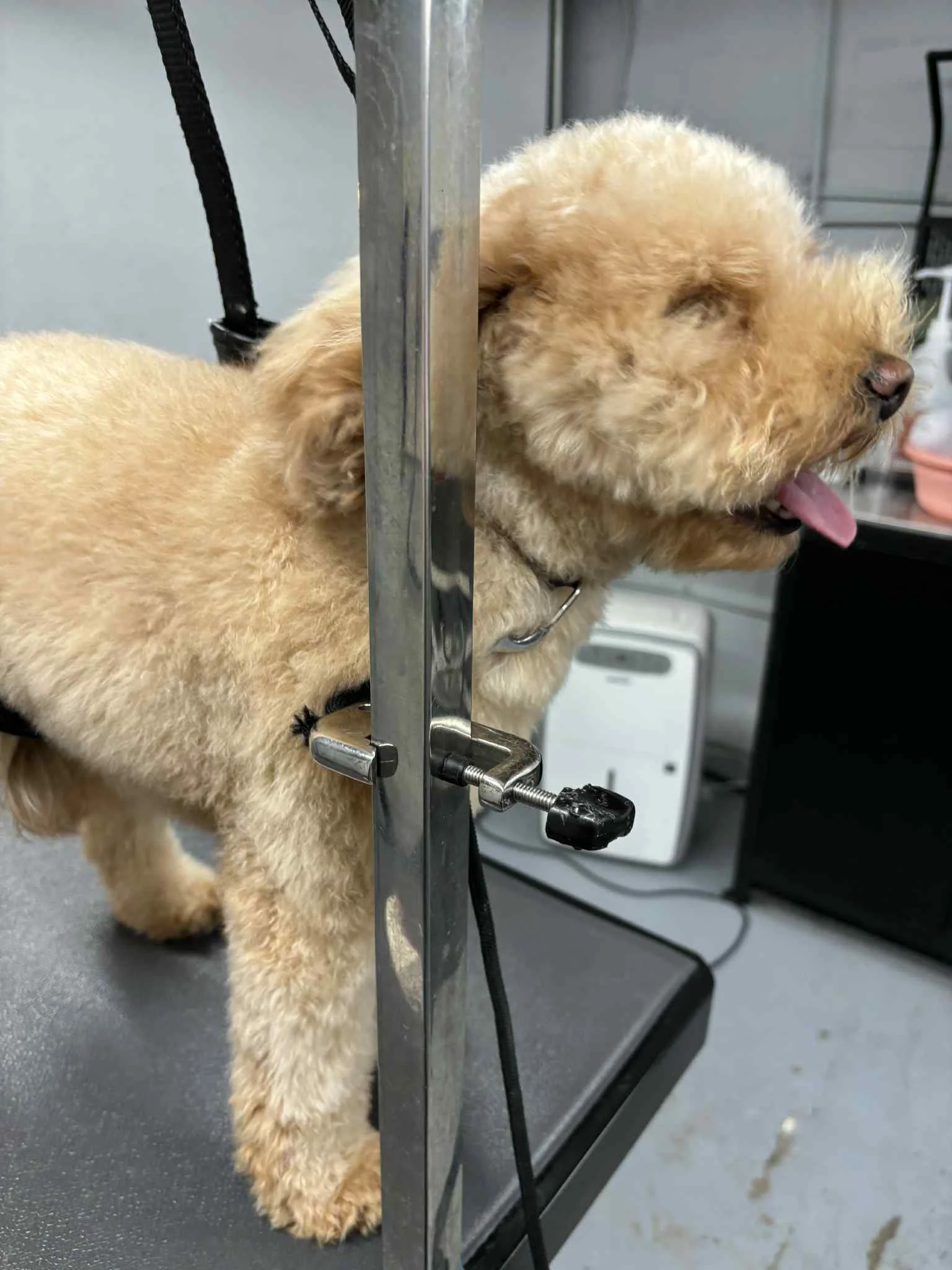
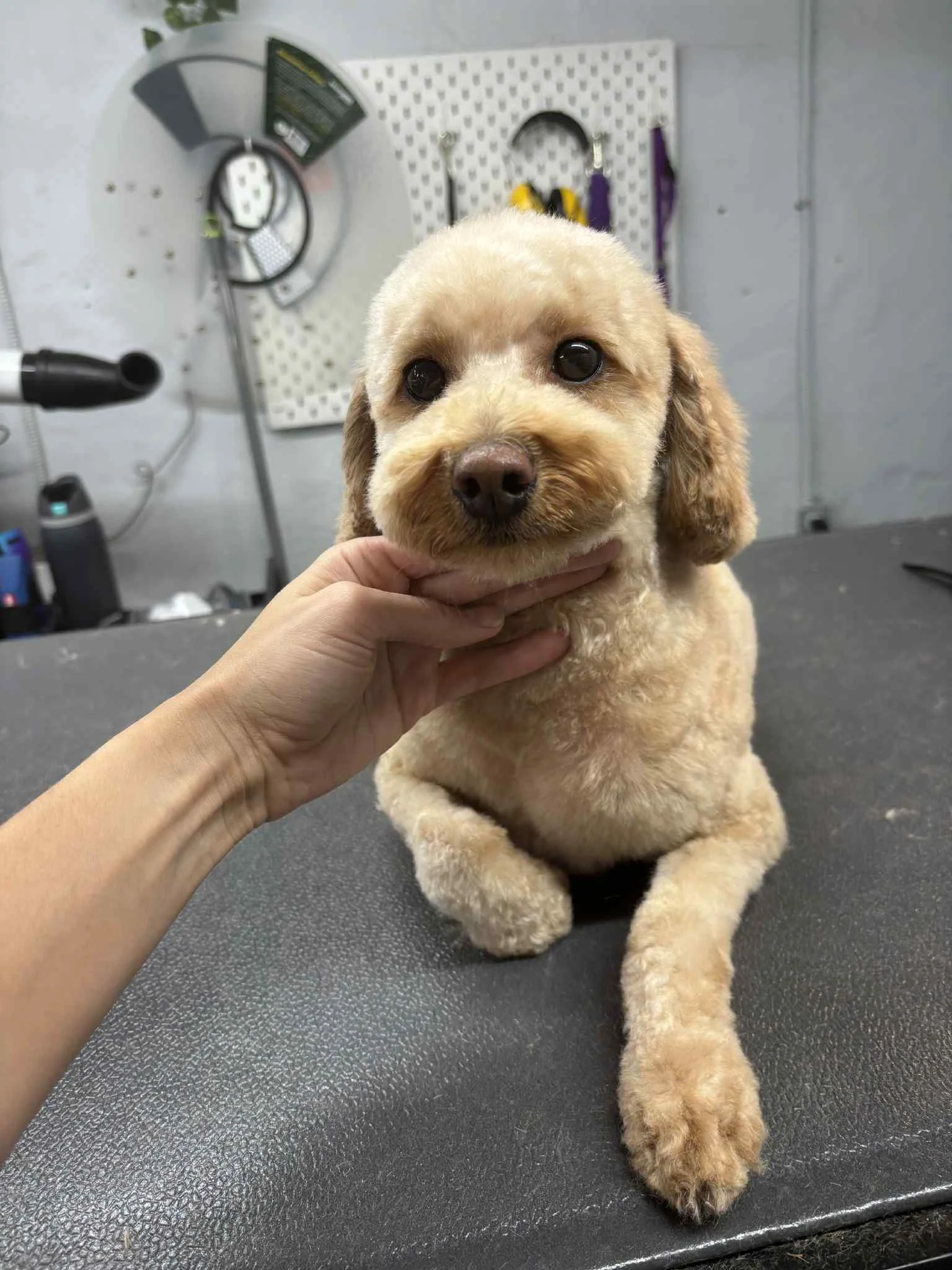
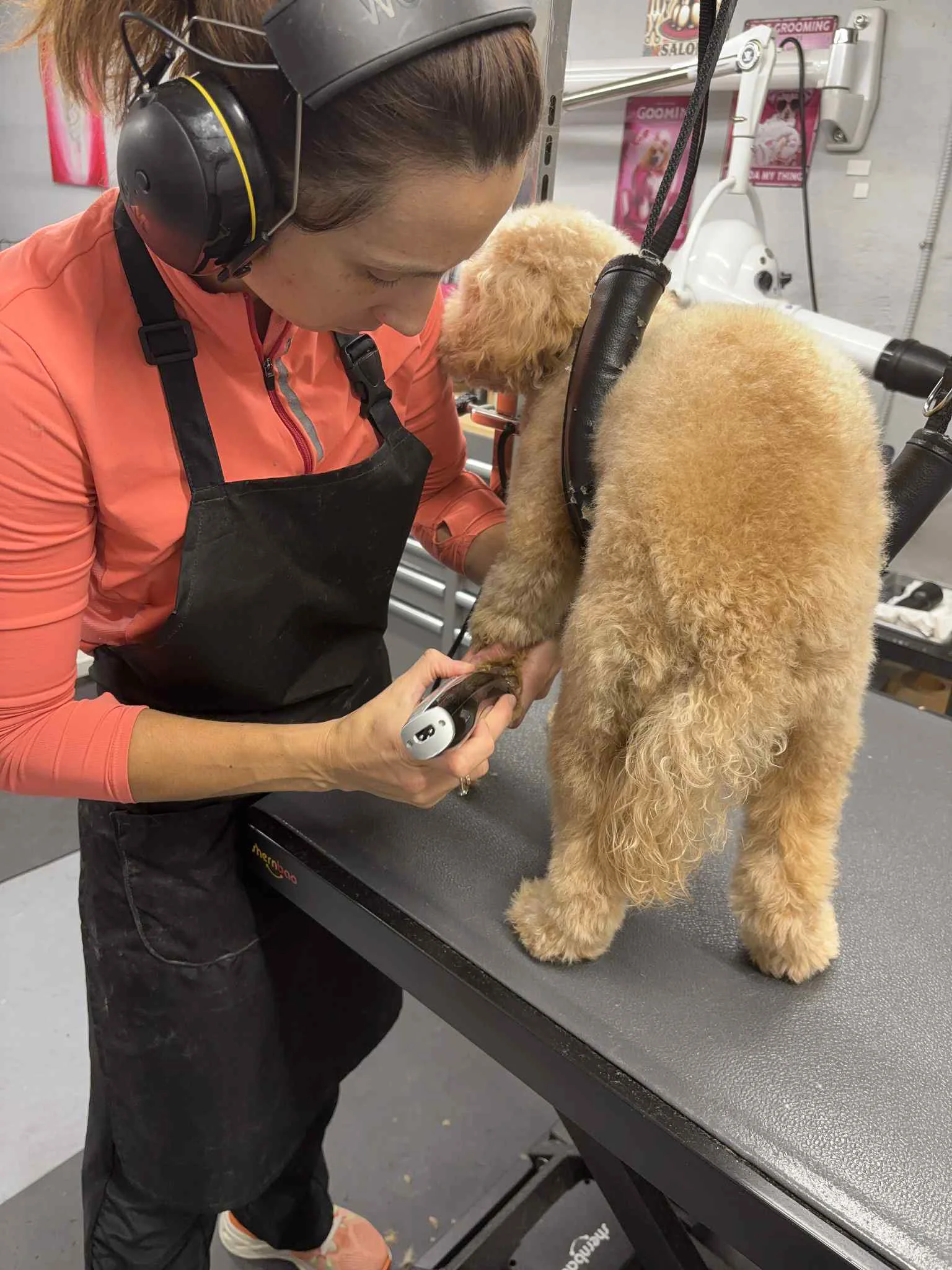
Ruby arrived nervous and needed the room to slow down. Read Ruby's full grooming story.
The doodles we see most
Doodle is a coat description more than a breed. Two goldendoodle littermates can need completely different schedules, so we plan around the coat in front of us.
Goldendoodles
The most common doodle we see. Coats range from loose waves to tight curls, and littermates often need completely different schedules. Golden retriever undercoat plus poodle curl is the classic matting combination.
Bernedoodles
Big dogs with heavy, dense coats. Brushing and drying both take real time, and the tri-colour coat hides matting well until a comb goes in. Standards need the most chair time of any doodle we groom.
Cockapoos
Small enough that owners often skip the comb, and the mats show up behind the ears and in the pantaloons first. Cocker ear leather also means ear care matters more than most owners expect.
Labradoodles, sheepadoodles and the rest
Including mini and medium versions of every cross. The coat in front of us decides the plan — not the name on the adoption paperwork.
Doodles who find grooming hard
A three-hour appointment is a long time for a dog who is not comfortable, and adolescent doodles in their coat change are often the ones asked to sit through the longest sessions of their lives. Every groomer here is Fear Free certified, and we work one dog at a time on the ground floor — no crowded salon floor, no waiting in a run.
If your doodle struggles, look at Fear Free dog grooming, anxious dog grooming, or a one-on-one session — the quiet, private format that worked for Ruby.
Doodle grooming FAQ
The questions doodle owners in Toronto ask us most, answered the way we answer them at the counter.
Related services
Book Doodle Grooming in Toronto
Tell us about the coat when you book and we will set aside the time it actually needs.